
ما هو موصل القسطرة؟

What Is a Catheter Mount? A Manufacturer’s Guide for OR, ICU, and Global Distributors
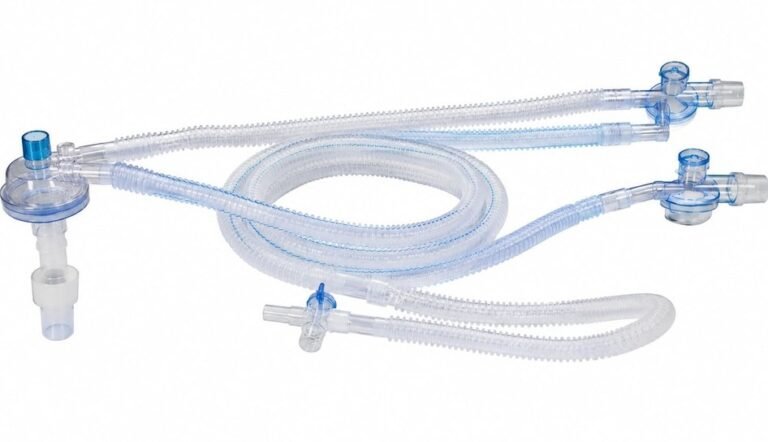
A catheter mount is a flexible, low dead-space breathing circuit connector that sits between the patient’s endotracheal (ET) tube or tracheostomy tube and the anaesthetic breathing circuit or ventilator Y-piece. Its job is mechanical, not pharmacological: it absorbs torque, weight, and movement from the circuit tubing so that none of that force is transmitted to the airway device sitting in the patient’s trachea. A 15mm female connector on one end mates to the ET tube or tracheostomy adapter, and a 22mm/15mm dual connector on the other end mates to the circuit or filter/HME. In practice, it’s the shock absorber of the airway — and it’s one of those unglamorous components that, when it fails or is chosen incorrectly, causes real clinical problems: accidental extubation, circuit disconnection, or unwanted rebreathing from excess internal volume.
If you manufacture or distribute respiratory consumables, you already know this part rarely gets marketing attention compared to filters or circuits — but it’s a high-volume, repeat-purchase SKU that anaesthesia departments and ICUs order by the thousands every month. Understanding the engineering behind it is what separates a distributor who can spec products intelligently from one who’s just reselling a catalog number.
Where It Sits and What It Actually Does
The airway connection chain, in order, typically looks like this:
ET tube / tracheostomy tube → catheter mount → HME filter (optional) → breathing circuit → anaesthetic machine or ventilator
Three functional roles define the device:
- Strain relief / torque isolation — The catheter mount’s flexible, often corrugated or accordion-style body decouples circuit movement (from patient repositioning, surgical draping, or ventilator tubing weight) from the fixed ET tube, reducing risk of tube kinking, cuff displacement, or accidental extubation during long procedures.
- Access port for suction/bronchoscopy — Many designs include a sealed side port with a silicone diaphragm, allowing a suction catheter or fiberoptic bronchoscope to pass through without breaking the ventilation circuit or losing PEEP — this is precisely the origin of the name “catheter mount,” referring to the port that mounts a suction catheter.
- Flexible articulation — It allows the circuit to approach the airway from an angle without pulling on the tube, which matters enormously in prone positioning, head and neck surgery, and cramped ICU bed setups.
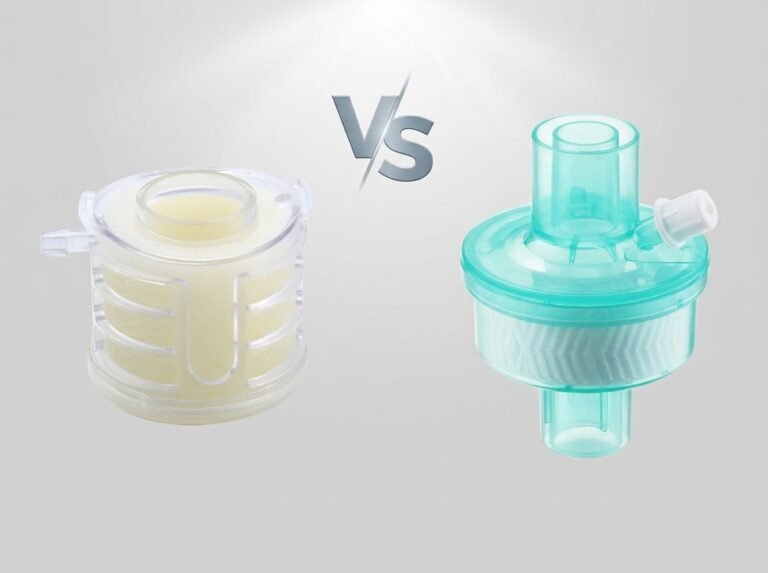
It is not a filter, not a humidifier, and not a heat-and-moisture exchanger — although many clinical kits bundle a catheter mount with an integrated HME (sometimes marketed as a “catheter mount with filter”) to save one connection point and reduce total dead space in the circuit.
Catheter Mount Use in Daily Anaesthetic and ICU Practice
As an anaesthetic catheter mount, the device shows up in nearly every general anaesthesia case involving intubation, and it’s a near-universal fixture in ICU ventilator circuits for intubated or tracheostomized patients. Typical use cases:
- General surgery under GA — connecting the ET tube to the circuit while allowing the anaesthetist to reposition the patient or drape the surgical field without dragging on the airway.
- ENT and maxillofacial surgery — where the surgical field is close to the connection point and a flexible, low-profile mount prevents the circuit from crowding the surgeon’s working space.
- Prone-position spine surgery — where the airway is turned away from the anaesthetist and circuit tension is a real extubation risk.
- ICU long-term ventilation — where a mount with a bronchoscopy/suction port lets nursing staff suction secretions or the ICU team perform bedside bronchoscopy without disconnecting the ventilator and losing lung recruitment.
- Tracheostomy care — connecting a tracheostomy tube to a ventilator circuit or T-piece, often for weaning trials.
Smooth Bore vs. Expandable (Corrugated) — Why the Difference Matters
This is where a lot of buyers get it wrong, and it’s the single biggest technical decision behind “which catheter mounts adapter do I actually need.”
| Parameter | Smooth Bore Catheter Mount | Expandable / Corrugated Catheter Mount |
| Internal wall | Straight, smooth lumen | Ribbed/accordion, extendable length |
| Dead space | Lower and fixed | Higher, and increases when stretched |
| Flexibility | Moderate, fixed length | High — extends to accommodate patient movement/draping |
| Risk of secretion pooling | Lower | Higher — corrugations can trap condensate/secretions |
| Typical setting | Neonatal/paediatric anaesthesia, low-flow circuits where minimizing rebreathing is critical | Adult general anaesthesia, ICU, cases needing reach and flexibility |
| Kink resistance | Good | Excellent, due to accordion structure |
A mismatch here is a common root cause of clinical complaints. Using a corrugated, extendable mount in neonatal anaesthesia adds dangerous rebreathing volume. Using a rigid smooth-bore mount in a prone spine case with a distant anaesthesia machine can leave insufficient slack and pull directly on the ET tube. Distributors sourcing catheter mounts adapter sets for hospital tenders should always confirm which bore type the buyer’s clinical protocol specifies — it’s usually written into the hospital’s anaesthesia SOP, not left to the supplier’s default catalog item.
Why Disposable Catheter Mounts Are Now the Hospital Default
Single-patient-use, disposable catheter mounts have become the standard of care in virtually every accredited hospital system, and for good reason:
- Cross-infection control — A catheter mount sits directly in the ventilation pathway of the airway, in continuous contact with respiratory secretions, condensate, and aerosolized pathogens. Reprocessing (cleaning, disinfecting, re-sterilizing) a reusable mount introduces validation burden, cost, and residual bioburden risk that most infection control committees are no longer willing to accept post-COVID.
- Consistent mechanical performance — Reused corrugated PVC mounts lose flexibility and develop micro-cracks after repeated autoclave cycles, degrading both seal integrity and torque-absorption performance. A disposable catheter mount guarantees first-use mechanical properties every time.
- EO-sterilized, individually packed supply chain — Standardizing on single-use units simplifies procurement and stock rotation for CSSD and OR supply teams, and removes an entire reprocessing workflow from hospital operations.
For any hospital group, GPO, or national distributor building a respiratory consumables formulary, specifying disposable catheter mount as the default SKU — rather than mixing reusable and disposable stock — is now the safer procurement policy from both a clinical and liability standpoint.
Catheter Mount Price: What Actually Drives the Number
Buyers frequently benchmark quotes against catheter mount intersurgical products, since Intersurgical is one of the most recognized OEM names in this category globally and its catalog pricing is often used as the reference point in tenders. That’s a reasonable starting point, but the price gap between an established multinational brand and a direct factory source isn’t about a mystery discount — it comes down to a handful of concrete cost drivers:
- Raw material grade — Medical-grade PVC or EVA compound cost varies meaningfully depending on plasticizer type (DEHP-free formulations cost more) and virgin-vs-regrind resin ratios. Genuine medical-grade, biocompatible resin batches carry documented traceability and cost more than commercial-grade plastic — this is a legitimate driver of unit price, not a place to cut corners.
- Sterilization method and validation — EO (ethylene oxide) sterilization with full residual testing (per ISO 10993-7) and batch release documentation adds cost versus unvalidated or gamma-shortcut processes. A landed price that looks unusually low often signals a corner cut here.
- Cleanroom production class — Extrusion, port-welding, and packaging performed in a Class 100,000 (ISO 8) or better cleanroom environment, with controlled particulate and bioburden monitoring, costs more to operate than an open-shop assembly line, but it’s what supports CE/FDA-compliant documentation.
- Tooling and mold ownership — Factories that own their own extrusion dies and injection molds for connectors can offer more stable, negotiable pricing than trading companies reselling someone else’s stock.
- Order volume and Incoterms — FOB Ningbo/Shanghai pricing on container-load volumes is structurally different from LCL or sample-quantity pricing; distributors comparing “catheter mount price” line items across quotes should always normalize for Incoterm, MOQ, and payment terms before comparing numbers directly.
Sourcing directly from a manufacturing factory based in Ningbo — inside China’s largest cluster for medical tubing extrusion and respiratory consumables — gives global distributors two structural advantages over buying through a branded distributor layer: shorter, more transparent supply chains (fewer intermediary markups between resin purchase and finished goods), and better production flexibility for OEM/ODM customization (private label packaging, custom connector configurations, bore-size variants) without the minimum order thresholds that branded multinational suppliers typically impose.
Technical Specification Benchmarking
| Specification | Typical Adult Catheter Mount | Typical Paediatric/Neonatal Catheter Mount |
| Length (relaxed / extended) | 100–150mm / up to 320mm (corrugated) | 60–90mm, mostly smooth bore |
| Connectors | 15F/22M – 15M/22F dual-lock | 15F – 15M |
| Internal diameter | ~15mm | 8–10mm |
| Dead space volume | 8–15 mL (smooth) / up to 25 mL (corrugated, extended) | 2–5 mL |
| Compliance | Low, for stable circuit pressure transmission | Very low, to protect fragile paediatric tidal volumes |
| Suction/bronchoscopy port | Optional, silicone self-sealing diaphragm | Rarely fitted |
| Material | Medical-grade PVC or EVA | Medical-grade PVC or EVA |
| Sterilization | EO sterilized, single-use | EO sterilized, single-use |
| Latex content | Latex-free (standard) | Latex-free (standard) |
| Packaging | Individually peel-pouch packed | Individually peel-pouch packed |
Dead space is the parameter clinicians scrutinize most closely, since excess dead space in a paediatric or neonatal circuit directly increases CO2 rebreathing risk — this is why neonatal catheter mounts are almost always smooth bore rather than expandable.
A catheter mount is typically classified as a Class I or Class IIa medical device (breathing/airway accessory), depending on jurisdiction and whether it’s sold as a standalone component or as part of a kit with an integrated filter. In the EU, this falls under MDR Class I/IIa depending on invasiveness and duration of use; in the US it’s generally regulated under 21 CFR 868 as an anesthesia/respiratory accessory, often under a 510(k)-exempt or Class I listing. When evaluating a supplier, request the CE Declaration of Conformity, ISO 13485 certificate, FDA establishment registration/listing (if applicable), and — critically — the EO sterilization validation report and biocompatibility (ISO 10993) test data specific to the resin batch used. Don’t accept a generic factory-wide ISO 13485 certificate as a substitute for product-specific technical documentation; customs and hospital procurement teams in most markets will ask for both.
Catheter mounts are most commonly classified under HS code 9018.90 (instruments and appliances used in medical sciences, not elsewhere specified) in many countries, though some customs authorities classify breathing circuit accessories under 9019.20 depending on local tariff schedules. The classification generally doesn’t change between disposable and reusable versions, since it’s based on device function rather than intended reuse — but duty rates, VAT treatment, and import licensing requirements (particularly medical device import permits) can vary significantly by destination country
MOQ is 1pc,Lead time is 15days from confrim the order.
Sourcing Disposable Catheter Mounts from Weishan Tech
ويشان تيك manufactures disposable and anaesthetic catheter mounts at our own cleanroom facility in Ningbo, China, covering smooth bore and expandable/corrugated designs, with and without integrated suction ports, across adult and paediatric connector sizes. We supply global distributors, hospital group buyers, and OEM/ODM partners under private label, with full documentation packages (CE, ISO 13485, EO sterilization validation, biocompatibility reports) ready for tender submission.