
ما هو قناع الأكسجين البسيط؟

ما هو قناع الأكسجين البسيط؟
Let’s start with plain talk
If you’ve ever visited someone in a hospital, you’ve probably seen this: a clear plastic mask sitting over a patient’s nose and mouth, a few small holes on each side, and a tube running back to an oxygen tank or wall outlet.
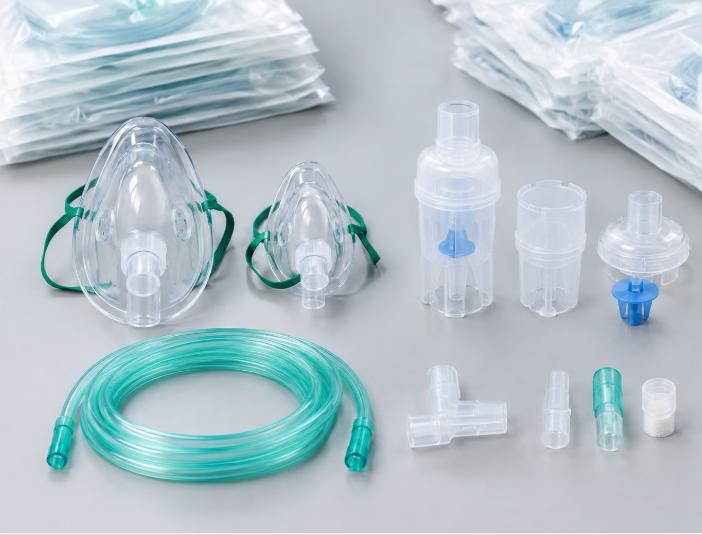
It has a proper name — a simple oxygen mask. Some people just call it a simple face mask, which is the same device, just a slightly different way of saying it. And the word “simple” actually fits. There’s no reservoir bag, no one-way valve, nothing complicated going on inside. Just a shell, a strap, and the most basic setup you can build to get oxygen to someone’s face.
Where does it actually get used? Mostly short-term, stopgap situations. A patient coming out of anesthesia whose oxygen levels have dipped a little. Someone in the ER who isn’t critical but still needs a boost. Paramedics carry these in the ambulance too. It’s not something meant for years of daily use — it’s more of a “let’s get you stable for now” tool.
So if someone asks what this thing is, the short answer is: a low-tech, short-term device built to deliver low-to-moderate concentrations of oxygen when a patient needs a bit of extra help.
Why the design is more thought-out than it looks
It looks basic, but pick one up and you’ll notice there’s more going on than meets the eye.
Start with the material. Decent ones are made from medical-grade, clear, non-toxic PVC — soft to the touch, no hard edges digging into the skin. The clear part matters more than people realize: nurses can see a patient’s lips and skin tone right through the shell without lifting the mask off, which means they catch the early signs of oxygen deprivation faster. That’s exactly why hospitals almost always reach for a transparent simple facemask instead of an opaque one.
Those little holes on each side aren’t decoration. They’re called side vents, and they exist because breathing works both ways — you inhale oxygen, you exhale carbon dioxide. If the mask sealed too tightly, that exhaled CO2 would just build up inside the shell instead of escaping, and the patient would start feeling smothered and short of breath. The vents give that stale air somewhere to go. Skip this detail, and most patients would be tearing the mask off within ten minutes.
How securely it stays on comes down to a small clip across the bridge of the nose — an adjustable nose clip that can be pinched into the shape of just about anyone’s nose to cut down on air leaking out the top. Pair that with an elastic strap around the back of the head, and you’ve got something that can be loosened or tightened as needed. This matters especially for children with smaller faces or older adults with looser skin — without an adjustable fit, the mask either digs in or slides right off.
The tubing running to the mask deserves a mention too. Good tubing is kink-resistant, so it doesn’t collapse shut if a patient rolls over on it, a blanket presses down on it, or a chair leg pins it to the floor — the small accidents of everyday care. It’s easy to overlook, but if that tube gets pinched flat, none of the careful design in the mask itself matters anymore.
Put it all together — lightweight, breathable, well-fitted, durable — and you get why this kind of simple mask has become the default oxygen tool in hospitals everywhere. Nothing flashy. Just a handful of small problems, each one actually solved.
أسئلة متكررة
That’s the quick version, but here’s why it plays out that way. A nasal cannula is just two small prongs that sit in the nostrils, so patients can talk and eat normally while wearing it — that’s why it’s the go-to choice for long-term, steady oxygen needs. A lot of home setups people describe as an oxygen nose mask are really this style. A simple oxygen mask, by contrast, seals over the whole nose and mouth, which is what lets it push concentration higher — but it also means talking or drinking isn’t practical while it’s on. Doctors typically choose between the two based on how low a patient’s oxygen saturation has dropped and how quickly it needs to come back up. Neither one is objectively better; each fits a different clinical moment.
A bit more detail on each step: get the oxygen flowing first — putting the mask on cold and airless makes that first breath feel stifling, and people instinctively want to pull it right back off. Once it’s in place, take a second to shape the nose clip to the bridge of the nose; this step gets skipped constantly, and it’s exactly what determines whether air leaks out around the top.
Yes — a simple oxygen mask can be used at home for short-term oxygen therapy, but only with a doctor’s prescription, a proper oxygen source, and correct flow-rate settings; it isn’t meant for continuous, long-term daily wear.
The short version
At the end of the day, the reason this mask has stuck around in hospitals for so long isn’t some clever piece of technology — it’s that a handful of small problems got solved properly. Soft material, breathable side vents, an adjustable nose clip, tubing that doesn’t collapse. It looks plain, but every detail is quietly doing a job.
Whether it’s sitting in a hospital supply closet or tucked in a home first-aid kit, the things worth checking are the same: is the material medical-grade, does it fit securely, are the vents doing their job. Whether you call it a simple oxygen mask or a simple face mask, get those basics right, and this “familiar but easy-to-overlook” piece of equipment will do exactly what it’s meant to do.