
What Is a Venturi Mask? How Venturi Oxygen Masks Work

What Is a Venturi Mask? How Venturi Oxygen Masks Work
What Is a Venturi Mask?
A venturi mask is an oxygen-delivery device used to give patients a precise, fixed percentage of inspired oxygen (FiO2), rather than the variable percentage delivered by a standard nasal cannula. It is one of the few oxygen devices classified as “high-flow, fixed-performance,” meaning the FiO2 a patient receives stays constant even if their breathing rate or depth changes.
Clinically, this makes the venturi mask oxygen system the preferred choice whenever precise oxygen titration matters — most notably in COPD patients, where delivering too much oxygen can suppress the natural drive to breathe.
How Venturi Masks Work
Venturi masks are designed to mix oxygen with room air in a fixed, predictable ratio, using a principle from fluid dynamics called the Venturi effect. Oxygen is pushed through a narrow orifice in a color-coded adaptor, which speeds up the gas flow and drops its pressure. This pressure drop pulls in a set volume of surrounding room air through side ports, and the two gases mix before reaching the mask.
Because the orifice size and air-entrainment ports are fixed for each adaptor, the resulting oxygen concentration is highly predictable — typically within 1–2% of the labeled value, regardless of how the patient is breathing.
Understanding FiO2 Settings and Color Codes
Each venturi mask oxygen adaptor is color-coded to a specific FiO2 percentage, so clinicians can adjust oxygen therapy at a glance:
- Blue — 24% FiO2, for tightly controlled low-flow therapy
- Yellow — 28% FiO2, common in COPD management
- White — 31% FiO2
- Green — 35% FiO2
- Pink — 40% FiO2
- Orange — 50% FiO2, for higher oxygen demand
This color-coding is standardized across most manufacturers, which is why hospitals can switch suppliers without retraining staff on dosing.
Standard Venturi Mask vs. Venturi Trach Mask
The core mixing technology is identical, but the patient interface differs:
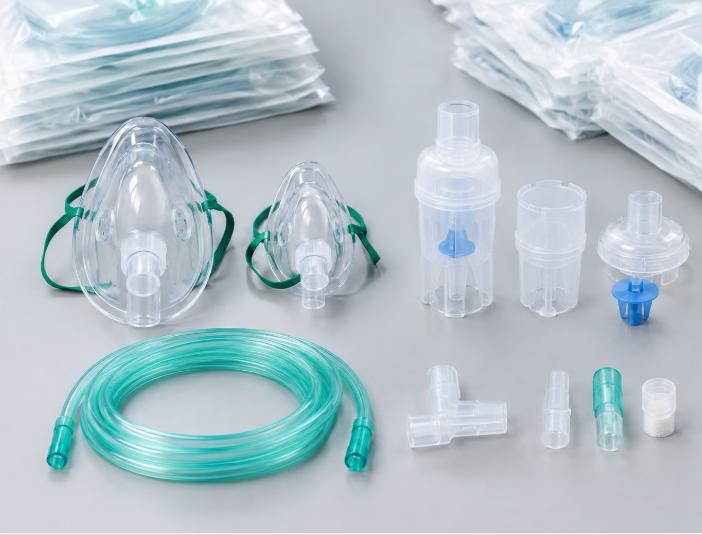
- Standard venturi oxygen mask — fits over the nose and mouth with an elastic strap and adjustable nose clip, for patients breathing through a natural airway.
- Venturi trach mask — connects directly to a tracheostomy tube, delivering the same fixed FiO2 without a facial seal, and is designed to minimize dead space for tracheostomy or post-laryngectomy patients.
When Is a Venturi Mask Used?
- COPD and other conditions where precise, low-dose oxygen is required to avoid CO2 retention
- Post-operative recovery and emergency department triage
- Patient transport, where a stable, predictable FiO2 is critical
- Tracheostomy and post-laryngectomy care, using the trach configuration
Choosing a Reliable Venturi Mask Supplier
Because FiO2 accuracy depends on manufacturing precision — orifice size, entrainment port tolerance, and tubing quality all affect performance — distributors and hospitals should source from a manufacturer with verifiable quality certifications rather than relying on labeled percentages alone.
For full technical specifications, FiO2 accuracy data, and details on both standard and tracheostomy configurations, see our Venturi Oxygen Mask product page, where all units are FDA-registered, CE-marked, and compliant with EU MDR (2017/745).
A Note on Terminology
This device is sometimes searched for or referred to under alternate spellings, including ventiri mask, venti-mask, or venti mask oxygen. These all describe the same fixed-performance venturi oxygen mask system covered in this article.