
Mapleson Breathing Circuits Explained: Types A–F, Working Principles, and Clinical Selection Guide

Mapleson Breathing Circuits Explained: Types A–F, Working Principles, and Clinical Selection Guide
Mapleson breathing circuits are semi-closed anesthesia delivery systems classified into six types (A, B, C, D, E, and F) based on the arrangement of fresh gas inlet, APL valve, reservoir bag, and breathing tubing. They are widely used in general anesthesia to deliver oxygen and volatile agents while preventing CO₂ rebreathing. This guide from WeishanTech covers how each circuit works, when to use it, and how to choose the right type for different clinical scenarios.
What Is a Mapleson Breathing Circuit?
A Mapleson breathing circuit is a semi-closed anesthesia breathing system that relies on continuous fresh gas flow (FGF) — rather than chemical CO₂ absorption — to wash out expired carbon dioxide and prevent the patient from rebreathing. The system was first classified by William Wellesley Mapleson in 1954 and remains one of the most referenced frameworks in anesthesia education worldwide.
What Are the Five Core Components?
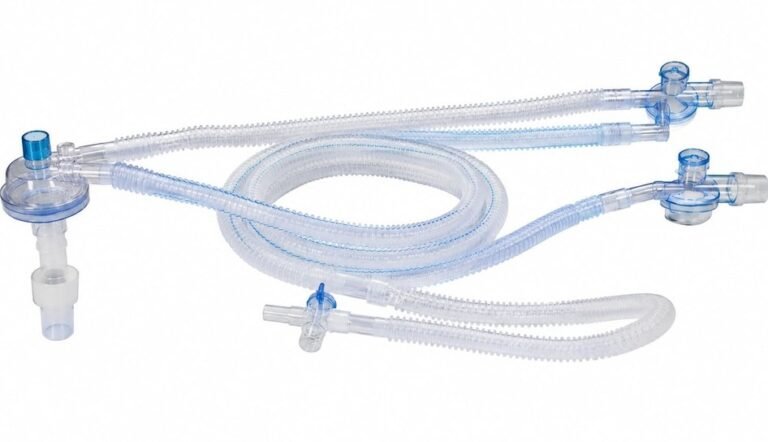
Every Mapleson circuit consists of five essential components:
- Fresh gas inlet — the point where oxygen and anesthetic agents enter the circuit from the anesthesia machine.
- Corrugated breathing tubing — flexible tubing that connects the machine end to the patient end and serves as a reservoir for gas.
- Adjustable pressure-limiting (APL) valve — also called a pop-off valve, it vents excess gas to prevent pressure buildup.
- Reservoir bag — a compliant bag that stores gas during the expiratory phase and provides a visual indicator of ventilation.
- Patient connection port — the interface (mask, endotracheal tube, or LMA) that connects the circuit to the patient’s airway.
The position of these five components relative to each other is what defines each Mapleson type (A through F) and determines its efficiency for spontaneous or controlled ventilation.
How Do Mapleson Circuits Differ from Circle Breathing Systems?
Mapleson circuits eliminate CO₂ by flushing it out with high fresh gas flow. Circle systems use a chemical CO₂ absorber (soda lime) to scrub exhaled carbon dioxide, allowing much lower fresh gas flow rates.
| Feature | Mapleson Circuits | Circle Systems |
| CO₂ removal method | Fresh gas flow flushing | Chemical absorption (soda lime) |
| FGF requirement | High (1–3× minute ventilation) | Low (0.5–1 L/min possible) |
| System complexity | Simple, few components | Complex, more components |
| Weight & portability | Lightweight, portable | Heavier, less portable |
| Gas economy | Low (higher waste) | High (gas conservation) |
| Best suited for | Short cases, pediatrics, field use | Long-duration procedures |
Who Invented the Mapleson Classification?
William Wellesley Mapleson (1926–2018), a physicist and physiologist at the University of Wales, published the original classification in 1954 in the British Journal of Anaesthesia. He mathematically analyzed rebreathing patterns across five semi-closed anesthetic systems and designated them Types A through E.
When Was Mapleson F Added?
Mapleson F was introduced in 1975 by Willis, Pender, and Mapleson. It incorporated the Jackson-Rees modification of the Ayre T-piece — adding a small open-tailed reservoir bag to the end of the Type E circuit. This modification solved the barotrauma risk associated with the original valveless T-piece design and became the standard circuit for neonatal and pediatric anesthesia.
How Does Each Mapleson Circuit Type Work?
Mapleson A (Magill System): Best for Spontaneous Breathing in Adults
Mapleson A is the most efficient circuit for spontaneously breathing adult patients. It requires a fresh gas flow of only approximately 1× the patient’s minute ventilation to prevent significant CO₂ rebreathing.
How Is Mapleson A Arranged?
The fresh gas inlet is located near the reservoir bag at the machine end. The APL valve is positioned at the patient end. Corrugated tubing connects the two.
How Does Gas Flow in Mapleson A?
During inspiration, the patient inhales fresh gas from the tubing while the APL valve stays closed. During exhalation, expired gas travels back toward the reservoir bag. As the bag fills, pressure rises and opens the APL valve, venting the exhaled gas to the atmosphere. Continuous FGF during the expiratory pause pushes remaining expired gas out through the valve before the next breath.
Dead-space gas (from the anatomical dead space, which did not participate in gas exchange and contains no excess CO₂) is allowed to re-enter the circuit. This is a key reason Mapleson A achieves high efficiency at relatively low flow rates.
What Are the Drawbacks of Mapleson A?
The APL valve is located close to the patient’s face, making it difficult to access during head and neck surgery. Waste gas is vented near the surgical field, contributing to operating room pollution. The Lack modification addresses both issues by adding a separate expiratory limb that routes waste gas back to the machine end for scavenging.
Mapleson B and C: High Fresh Gas Flow Demand
Mapleson B and C are the least efficient circuits in the Mapleson classification. They require fresh gas flow rates equal to or exceeding the patient’s peak inspiratory flow rate to prevent rebreathing.
What Is the Difference Between Mapleson B and C?
Both place the fresh gas inlet and APL valve at the patient end, with the reservoir bag at the machine end. The only structural difference is that Mapleson B includes corrugated tubing between the patient connection and the reservoir bag, while Mapleson C omits it — making C a shorter, more compact variant.
Why Are Mapleson B and C Inefficient?
In both circuits, exhaled gas mixes with fresh gas in the tubing and bag. When the patient takes the next breath, the inspired mixture inevitably contains some previously expired gas. Preventing clinically significant rebreathing requires extremely high FGF rates, resulting in high gas consumption and significant waste. This is why Mapleson B and C are rarely selected for routine clinical use in modern practice.
Mapleson D: Best for Controlled (Mechanical) Ventilation
Mapleson D is the most efficient circuit for controlled ventilation in adult patients. The Bain modification of Mapleson D is one of the most widely used semi-closed circuits in modern anesthesia practice.
How Is Mapleson D Arranged?
Fresh gas enters at the patient end via a T-piece connection. The APL valve and reservoir bag are positioned at the machine end, connected to the patient by an expiratory limb of corrugated tubing.
How Does Gas Flow in Mapleson D?
The patient inspires from the FGF and the proximal tubing. On exhalation, expired gas flows into the corrugated tubing and toward the reservoir bag. Continuous FGF progressively displaces expired gas further down the tube. When bag pressure rises sufficiently, the APL valve opens and vents excess gas. Between breaths, FGF refills the proximal tubing with fresh gas, pushing expired gas away from the patient.
An FGF of 2–3× the patient’s minute ventilation is generally sufficient to prevent rebreathing during controlled ventilation.
What Is the Bain Modification?
The Bain circuit is a coaxial version of Mapleson D. The fresh gas delivery tube runs inside the corrugated outer tubing (“tube within a tube”). This design offers three advantages: reduced physical bulk, a more streamlined circuit profile, and partial warming of inspired fresh gas by the surrounding exhaled gas in the outer tube — reducing patient heat loss.
Mapleson E (Ayre T-Piece): Valveless Design for Neonates
Mapleson E is a valveless breathing circuit derived from the Ayre T-piece. It provides near-zero resistance to airflow, making it particularly suitable for neonates and small infants with limited respiratory effort.
How Does Mapleson E Work?
Fresh gas enters at the patient end through a T-piece. The expiratory limb is an open-ended length of tubing whose internal volume exceeds the patient’s tidal volume. There is no APL valve and no reservoir bag. Expired gas simply exits through the open end of the tubing.
What Are the Risks of Mapleson E?
The absence of a reservoir bag means there is no pressure-buffering effect during controlled ventilation. If FGF significantly exceeds the escape capacity of the open tubing, excessive airway pressure can develop, leading to pulmonary barotrauma. The clinician also lacks the tactile and visual feedback that a reservoir bag provides.
Mapleson F (Jackson-Rees Modification): Standard Pediatric Circuit
Mapleson F is the most commonly used semi-closed breathing circuit for pediatric and neonatal anesthesia. It adds a small (approximately 500 mL) open-tailed reservoir bag to the expiratory limb of the Mapleson E system.
What Does the Reservoir Bag Add?
The bag provides three critical functions:
- Pressure buffering — the bag’s elastic compliance absorbs pressure spikes, protecting against barotrauma during controlled ventilation.
- Ventilation monitoring — rhythmic inflation and deflation of the bag during spontaneous breathing gives the clinician immediate visual feedback on respiratory rate, tidal volume, and effort.
- Manual ventilation control — the clinician can occlude the open tail of the bag with a finger to direct gas flow into the patient’s lungs and control airway pressure.
A PEEP valve can also be attached to the bag, converting the valveless system into one capable of maintaining positive end-expiratory pressure.
What FGF Rate Does Mapleson F Require?
Mapleson F requires high fresh gas flow rates — approximately 2.5–3× the patient’s minute ventilation — to prevent significant rebreathing. Waste gas scavenging is difficult because gas exits through the open-tailed bag rather than a dedicated scavenging valve.
How to Choose the Right Mapleson Circuit: Clinical Selection Summary
The correct Mapleson circuit depends on three primary factors: ventilation mode (spontaneous vs. controlled), patient age/size, and practical considerations such as surgical access and gas economy.
| Clinical Scenario | Recommended Circuit | FGF Requirement |
| Spontaneous breathing, adult | Mapleson A (Magill) | ≈ 1× MV |
| Controlled ventilation, adult | Mapleson D (or Bain) | 2–3× MV |
| Neonatal / pediatric | Mapleson F (Jackson-Rees) | 2.5–3× MV |
| Neonatal, minimal resistance | Mapleson E (Ayre T-piece) | 2.5–3× MV |
| Short procedures, field use | Mapleson A or D | Varies |
MV = Minute Ventilation
When Should You Use a Circle System Instead?
Circle systems are preferred over Mapleson circuits for long-duration surgical procedures (typically >1 hour), when low-flow or minimal-flow anesthesia is desired for cost and environmental reasons, or when precise control of inspired anesthetic concentration is required. Mapleson circuits remain the better choice for short cases, pediatric anesthesia, transport/field settings, and situations where simplicity and low airway resistance are priorities.
Key Technical Specifications at a Glance
| Type | APL Valve | FGF Inlet | Reservoir Bag | Best For |
| A (Magill) | Patient end | Machine end | Machine end | Spontaneous ventilation, adults |
| B | Patient end | Patient end | Machine end | Rarely used clinically |
| C | Patient end | Patient end | Machine end | Rarely used clinically |
| D | Machine end | Patient end | Machine end | Controlled ventilation, adults |
| E (Ayre) | None | Patient end | None | Neonates (spontaneous) |
| F (J-Rees) | None (bag) | Patient end | Expiratory end | Neonates & pediatrics |
Frequently Asked Questions
Which Mapleson circuit is best for spontaneous breathing?
Mapleson A (the Magill system) is the most efficient circuit for spontaneous ventilation in adults. It minimizes CO₂ rebreathing at a fresh gas flow approximately equal to the patient’s minute ventilation.
Which Mapleson circuit is best for controlled ventilation?
Mapleson D, especially the Bain coaxial modification, is the most efficient circuit for controlled (mechanical) ventilation. It requires a fresh gas flow of 2–3× minute ventilation.
What is the difference between Mapleson E and Mapleson F?
Both are based on the Ayre T-piece. Mapleson E has no valve and no reservoir bag — it is a simple open-ended tube. Mapleson F adds a 500 mL open-tailed reservoir bag to the expiratory limb, providing pressure buffering, visual respiratory monitoring, and the option for manual ventilation control.
Why are Mapleson B and C rarely used?
Mapleson B and C require fresh gas flow rates equal to or exceeding peak inspiratory flow to prevent rebreathing. This makes them highly gas-consumptive and impractical compared to Mapleson A (for spontaneous breathing) or Mapleson D (for controlled ventilation).
What is the Bain circuit?
The Bain circuit is a coaxial modification of Mapleson D. The fresh gas tube runs inside the corrugated expiratory tubing, reducing bulk and allowing the exhaled gas in the outer tube to warm the incoming fresh gas — an advantage for reducing patient heat loss.
Do Mapleson circuits use CO₂ absorbers?
No. Mapleson circuits rely entirely on fresh gas flow to flush out expired CO₂. They do not contain soda lime or any chemical absorbent. This is the fundamental difference between Mapleson (semi-closed) circuits and circle (closed or semi-closed with absorber) systems.
About This Guide
This technical reference is published by WeishanTech (weishantech.com) as part of our anesthesia equipment knowledge base. WeishanTech provides professional-grade anesthesia breathing circuits, components, and accessories for hospitals, clinics, and distributors worldwide. For product inquiries or technical consultation, visit weishantech.com or contact our sales team directly.
Mapleson A (the Magill system) is the most efficient circuit for spontaneous ventilation in adults. It minimizes CO₂ rebreathing at a fresh gas flow approximately equal to the patient’s minute ventilation.
Mapleson D, especially the Bain coaxial modification, is the most efficient circuit for controlled (mechanical) ventilation. It requires a fresh gas flow of 2–3× minute ventilation.
Both are based on the Ayre T-piece. Mapleson E has no valve and no reservoir bag. Mapleson F adds a 500 mL open-tailed reservoir bag to the expiratory limb, providing pressure buffering, visual respiratory monitoring, and manual ventilation control.
Last updated: May 2026. This article is for educational purposes only and does not constitute medical advice. Always follow institutional protocols and manufacturer guidelines when selecting anesthesia breathing circuits.