
HME Filter Supplier Checklist for Buyers

HME Filter Supplier Checklist for Buyers
HME filter basics to look for from the start
Too many buyers sourcing HME filters fall in love with price and ignore the basics that will matter for the long-term. A stable supplier is worth more than a cheaper price on paper.
This HME filter checklist is written for those distributors, importers and medical buyers who will prefer to have fewer problems placed at their doorstep after signing on the dotted line, not more.
1, First, make sure it works!
Make the core function of the product your first check.
A “real” HME filter should achieve:
- High bacterial filtration efficiency (BFE)
- High viral filtration efficiency (VFE)
- Stability of test reports from one or short-term to another
Buyers in the ICU and anesthesia space typically expect no less than ≥99.99%. Walk away if the supplier cannot quote this clear to you upfront.
2, Check resistance to “flow”
This is a check-up too often disregarded, until there’s trouble.
High resistance translates to:
- Work of breathing for the patient
- Risk, particularly if the patient is pediatric or weak
- Poor acceptance from your clinicians
Ask for flow resistance data under standard conditions. Good suppliers won’t have to say “check, later.”
3, Moisture performance the other half
HME filters have to have humidification ability too. Make sure to check:
- Moisture output (mg/L)
- Stability of output vs time
- Comparative output vs different batches
You likely won’t catch low moisture performance in your ordering stage, but you will definitely hear complaints about it after the fact.
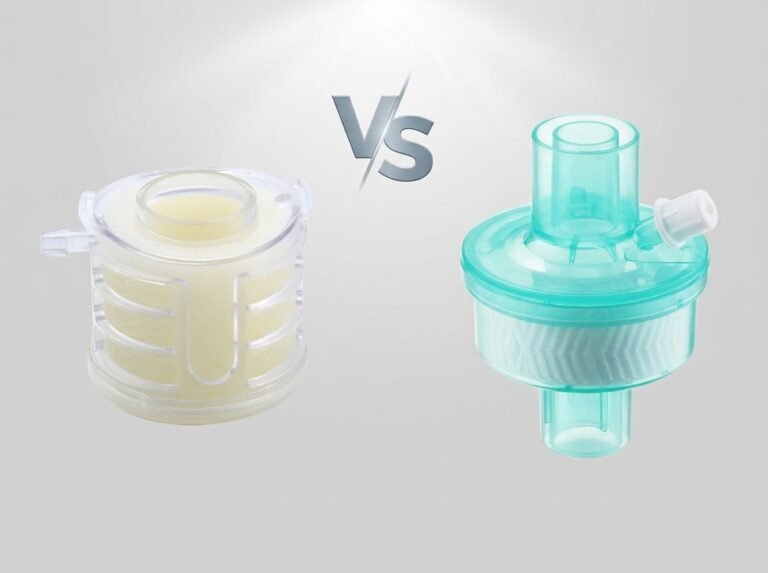
4, Do you know HME from HMEF?HME, HMEF
How many bells and whistles? Simple HME, or combined HMEF with a higher level of filtration? If your end-user is working in the intensive care sector or other medically sensitive areas, the latter is probably the way to go. If the filter is solely for the use of intubating patients for short-term anesthesia, the regular filter choice might suffice. Your filter supplier ought to be able to guide you in answering this question rather than attempting to sell you all one type or other.
Verify Connector Compatibility
Like the letter says, a tiny discrepancy can spell disaster. Does the HME filter;
- Fit standard 15mm / 22mm connectors?
- Fit tightly to the breathing circuits?
- Affect leakage at pressure?
These items are among the greatest source of complaint in this kind of filter.
Verify Consistency
Sampling then becomes a production question. Will the filters coming down the production line look just like the samples you inspected? Ask the supplier;
- Are you doing anything to control batch-to-batch differences in the filter?
- Do you have traceability for each lot of filter you supply?
- Can you document consistency over time?
Read some of the answers you get. The reliable filter manufacturer will not be vague in his replies.
Verify Certifications
Assuming you are going to export your filters, the documentation will not be optional. Generally speaking, they should include;
- ISO certification
- CE marking OR certification via FDA (depending upon which market you are heading for)
- Sterilization report
Other documentation may apply, and you will want to double-check the documents supplied, as well as ensuring they refer to the product and supplier you are actually buying from!
Examine Packaging
Most HME filters are single-used only, and are packaged up sterile. When figuring pricing than “going sterile” may factor into the price as well. Check such things as;
- Are the filters totally individually sterile packaged, including check-off labels?
- Is the lot number and expiry date clear?
- Are cartons accepted on strength for distribution?
You might wish to cross-check packaging against actual deterioration during delivery.
Verify Minimum Order Quantities and Lead times
In most industries, repeat sales are what count and you must have a supplier who can guarantee a supply of adequately filtered “breaths in jars,” so get those details worked out early. What is the;
- Minimum order quantity?
- Normal lead time?
- Flexibility regarding repeat orders?
A supplier who has not worked those options up and honed his skills in those areas may make many business ideas, however, may simply lose your business through inflexibility! Work with the other companies in the industry?
Assess Communication
Every bit as important as the rest of this, but easily ignored if it comes from just little old you! Check for;
- Speedy, clear responses
- A certain degree of technical understanding and even background
- Willingness to meet problems half way
Bad communication is one of the greatest reasons for orders being held up or not coming through. A few other points to be made, but basically this reference item is pretty much self-explanatory. The difference between a smooth order and a sticky, held order for filters mostly rests in the detail, filter data, etc., again. The supplier who is covering these points is already ahead of most others and you can expect less complaints, more orders, and more successful business partners!