
Expandable Anesthesia Breathing Circuits

Fifteen Years In, Here’s What Actually Matters
Last year a German buyer came to audit our factory. He brought the technical file from his previous Chinese supplier. When we got to the biocompatibility report, he pointed at the date — issued in 2019. The material batch number on the tested sample didn’t match the batch number on the goods he’d received in 2023. It wasn’t fraud. That factory had simply changed EVA resin suppliers twice over those four years and never updated the technical file.
This isn’t news in the industry. But it explains why more European buyers now skip the sample and the quote, and ask first for a screenshot of the DMR (Device Master Record) index. What they want to see isn’t the certificate itself — it’s whether the system behind the certificate is actually moving.
What follows is what fifteen years of OEM work on anesthesia breathing circuits, and a lot of back-and-forth with overseas customers, has taught us.
The Product: Where “Expandable” Earns Its Price
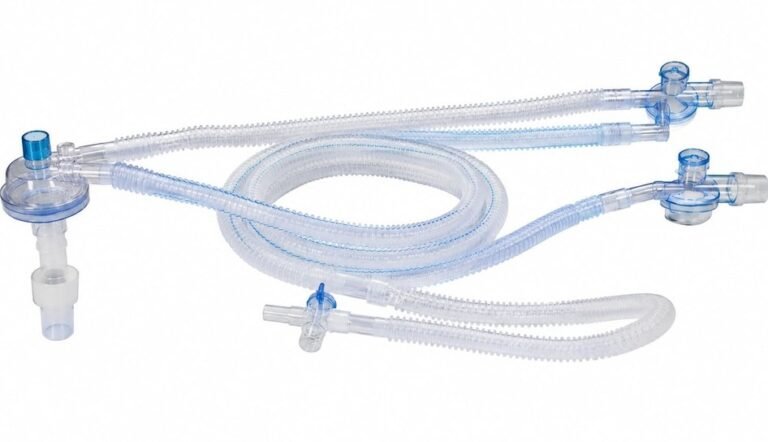
The structure isn’t complicated — EVA or modified PE extruded into corrugated tubing, compressed to around 50 cm, stretched to 150–180 cm in use. The real engineering sits in three places.
Compliance control. The volume change in the tube wall under 30 cmH₂O positive pressure, after stretching, directly affects tidal volume measurement accuracy. Putting a number on a spec sheet is easy; holding that number batch after batch is not. We keep ours under 1.5 mL per meter, sampled every two hours on the line.
Connector sealing. Flash, ovality, and dimensional drift on the 22 mm / 15 mm conical connectors determine whether the circuit leaks at the bedside. ISO 5356-1 is the standard, but passing a real negative-pressure test (-50 cmH₂O held 30 seconds, pressure drop under 5%) comes down to mold precision and injection parameter stability.
EO residuals after sterilization. ISO 10993-7 caps EO at 4 mg per device and ECH at 9 mg. Aeration physically takes 10–14 days; the temperature and humidity curve can’t be shortcut. If a supplier quotes 28-day lead time including sterilization, the math doesn’t work. They’re either shipping from existing stock or under-aerating.
Regulatory Files: What Buyers Are Actually Reading
For the EU, the CE mark under MDR now carries real weight — the transition has separated the serious manufacturers from the rest. Class IIa breathing circuits require technical file review by a Notified Body; self-declaration isn’t an option. Three things worth confirming:
Which Notified Body issued the certificate. BSI, TÜV SÜD, and DEKRA are the tier-one names. Certificates from smaller Eastern European NBs are, in practice, not accepted by the more careful distributors. Check the issue date — only certificates issued under MDR count; all legacy MDD certificates expired in 2024. And ask how often the CER (Clinical Evaluation Report) gets updated.
For the US, the 510(k) number is searchable in the FDA database. Watch the distinction between the 510(k) Owner and the actual Manufacturer — they aren’t always the same entity, and this determines who you’re actually doing business with.
The production address on the ISO 13485 certificate must match the manufacturer address on the export customs declaration. Takes three minutes to verify. Screens out a meaningful percentage of trading companies dressed up as factories.
Factory Audit: What One Day Can Tell You
Most overseas buyers can only spare a single day on site. Here’s how I’d prioritize it.
Start in the injection molding area. Look at the mold racks — do the molds carry identification numbers and maintenance log cards? Pull a few Y-pieces and connectors from the work-in-progress bins, measure the critical dimensions with calipers, compare to the drawings. This is how you find out whether process control is real or paperwork.
Then the cleanroom. ISO Class 8 (100,000-grade) is standard for this product category. The grade itself isn’t the point — what matters is whether the pressure differential logs, air change records, and personnel entry logs are filled in daily. The tell is the shutdown dates: are those rows blank, or do they say “no production”? That’s the difference between a system run for auditors and a system that actually runs.
Finally, EO sterilization and aeration. Look at the sterilizer model — domestic Xinhua units are standard, imported 3M or Steris is a plus. Check whether the aeration chamber has live temperature monitoring, and whether historical curves can be exported on request.
For documents, pick one finished product batch number. Ask the factory to pull the corresponding raw material batch records, sterilization batch, final inspection records, and release records on the spot. A system that’s actually operating can produce all of this within fifteen minutes.
Commercial Terms You Can Take at Face Value
MOQ: 2,000–5,000 pieces for standard SKUs; 10,000+ for OEM with custom printing, packaging, or bundled accessories. Any factory accepting less is likely a trading company passing the order along.
Lead time: 30–45 days for standard, 50–70 days for OEM, inclusive of EO sterilization and aeration. Those last two weeks are non-negotiable.
Payment: 30/70 T/T is the norm — 30% deposit, 70% against B/L copy. For first orders, a sight L/C is worth the cost. Let the bank take one layer of the risk.
Pricing basis: FOB Shanghai or Ningbo is cleanest. DDP pulls you into importer-of-record territory, and under EU MDR the Economic Operator obligations aren’t something you want a supplier absorbing casually. Both parties can end up exposed.
Closing
Certificates are the entry ticket. What actually separates suppliers is whether the technical file gets updated when a material batch changes, whether CAPA investigations reach the root cause after a complaint, and whether the logs shown during an audit were filled out that morning or over the past twelve months. These look like cost centers in the short run. In the long run they decide which factories make it to their second decade.
Technical file, recent test reports, and samples are available on request. It’s the fastest way to find out whether a supplier is worth a longer conversation.