
Guia de Fabricação de Consumíveis Respiratórios: Por que Circuitos Respiratórios e Filtros Precisam de Suporte de Fabricação de Nível Profissional

Guia de Fabricação de Consumíveis Respiratórios: Por que Circuitos Respiratórios e Filtros Precisam de Suporte de Fabricação de Nível Profissional
Having spent years on the production floor working with respiratory consumables — breathing circuits, oxygen masks, and breathing filters — the point I emphasize most often to customers is this: respiratory consumables look structurally simple, but they are a textbook example of a “tolerance-sensitive” product category. A 0.1 mm deformation at a connector, or a 0.5 cmH₂O deviation in resistance, can directly affect a patient’s ventilation safety. This is exactly why a genuinely professional medical devices manufacturer must apply near-obsessive control over precision molds, material selection, and process consistency.
1. Breathing Circuit Manufacturing: Controlling Connector Airtightness Through Precision Molds
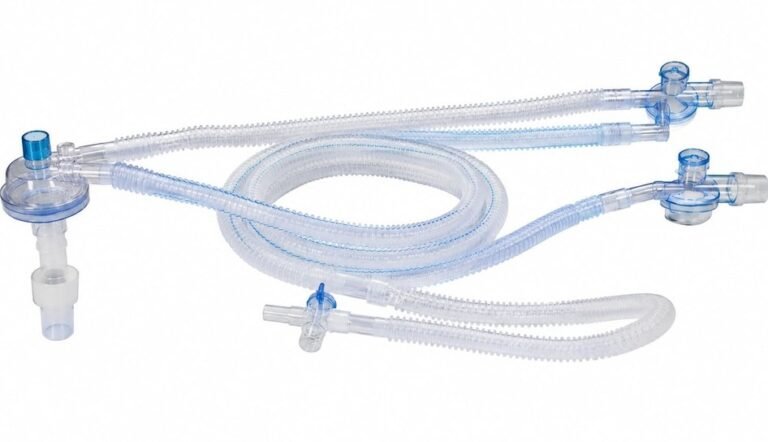
More than 90% of breathing circuit failure modes concentrate at connectors, elbows, and Y-piece junctions, where air leakage occurs. As a shared focal point for medical electronics manufacturers and plastic component suppliers alike, airtightness control must be engineered starting at the mold design stage:
Taper-Fit Tolerance Control
Breathing circuit connectors commonly use the 22mm/15mm taper interface defined by ISO 5356-1. Mold cavity taper tolerance must be held to roughly ±0.02mm; any cavity expansion caused by mold wear directly translates into a risk of loose connections. This requires a mold-life curve and periodic dimensional re-measurement program.
Shrinkage Compensation Design
Medical-grade PP and TPE materials exhibit subtle batch-to-batch variation in molding shrinkage. Shrinkage compensation must be built into the mold design stage and iteratively refined through first-article CMM (coordinate measuring machine) inspection, ensuring the taper mating surface remains stable across production volumes.
Weld Line Location Avoidance
Multi-gate molds are prone to forming weld lines at critical sealing surfaces, which can create microscopic porosity. Process engineers must use mold-flow analysis (Moldflow) to predict weld-line paths in advance and route them away from critical sealing zones.
100% In-Line Airtightness Testing
Finished parts are not sample-tested; they undergo 100% inspection on an airtightness test bench (typically set at 3–6 kPa positive pressure). Any unit with a pressure drop beyond threshold is automatically rejected — a non-negotiable step in the quality system of any credible healthcare equipment manufacturer.
2. Filter Production: How to Ensure Resistance Consistency
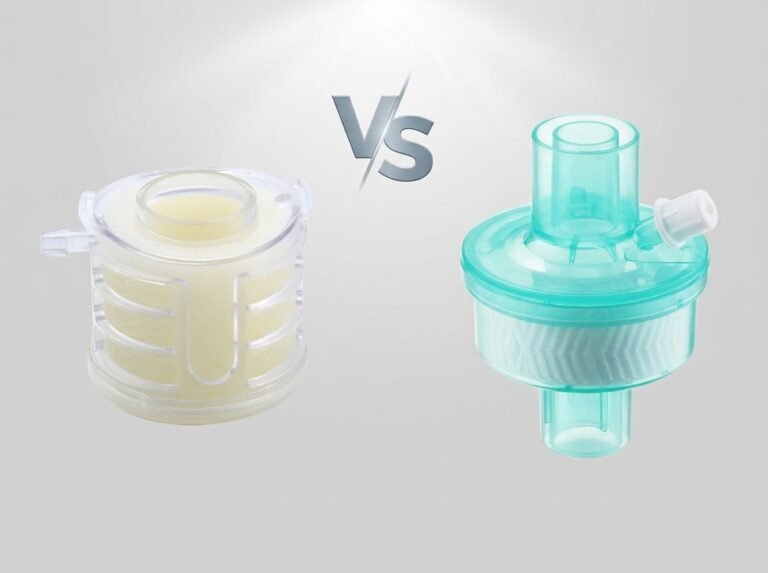
The core performance metric of a breathing filter (including viral filters / HMEF and heat-moisture exchangers / HME) is the balance between filtration efficiency and flow resistance. Poor resistance consistency can, at best, affect patient breathing comfort and, at worst, distort clinical ventilation data. Key control points include:
Filter Media Basis Weight and Density Uniformity
Basis-weight variation in meltblown filter media directly determines the resistance curve. Production requires an in-line basis-weight monitoring system, with batch-to-batch deviation typically controlled within ±3%.
Pleating Process Consistency
Filters typically use a pleated media structure to increase effective filtration area. Consistency in pleat spacing, count, and height directly affects the uniformity of airflow path, which requires servo-driven pleating equipment rather than manual folding to guarantee repeatable precision.
Batch Resistance Sampling Standards
Following EN 13328-1 or ISO 23328-1, pressure drop is measured at defined flow rates (e.g., 30 L/min, 60 L/min). Each batch must be sampled and a resistance-versus-flow curve plotted, ensuring curve overlap between batches stays within an acceptable range.
Heat-Sealing Parameter Control at the Sealing Edge
Temperature, pressure, and dwell time at the heat-sealing junction between filter media and housing must be controlled together. Poor sealing causes “bypass leakage,” which distorts measured resistance data without being easily detected — which is why the sealing process must also be subject to process validation (PQ).
3. The Logic Behind Medical-Grade Plastic Pellet Selection
As a manufacturer medical buyers can rely on, raw material selection is often far more granular than most buyers assume:
- Resin Grade Requirements: Breathing circuit tubing typically uses medical-grade PVC or TPE pellets, which must carry USP Class VI and ISO 10993 biocompatibility certification, with the supplier’s formulation locked (no substitution of additive or plasticizer suppliers without notice).
- Balancing Clarity and Flexibility: PVC tubing must remain flexible even at low temperature (to avoid brittleness during winter transport or use), which places clear requirements on plasticizer type (e.g., non-phthalate options such as DEHT, DINCH), while haze testing confirms clinical visibility.
- Pellet Batch Traceability: Each raw material batch must retain a COA (Certificate of Analysis) linked to the production batch, so that a raw-material-level anomaly (e.g., particle-size distribution shift causing MFR variation) can be quickly traced to the affected downstream product batches.
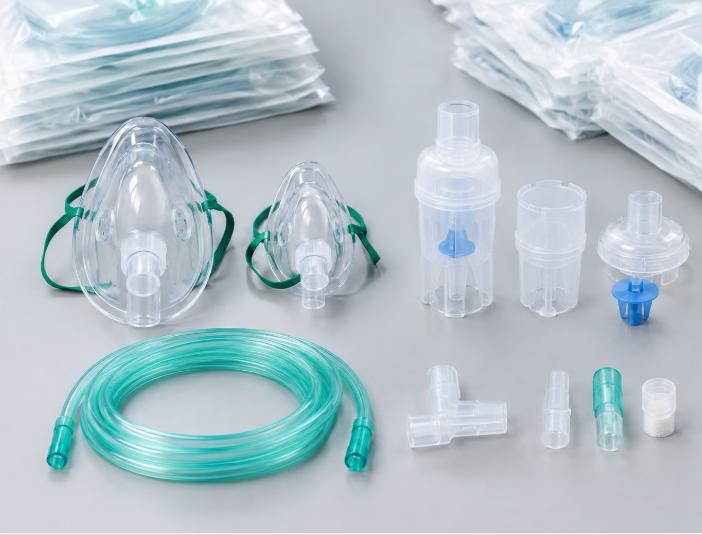
- Anti-Static and Cleanliness Requirements: Mask and filter housing components carry additional requirements around pellet dust content and anti-static treatment, to prevent surface particle adhesion after molding from compromising cleanliness specifications.
4. Frequently Asked Questions
Q1: A breathing circuit connector develops “progressive leakage” after a period of use — what typically causes this?
A: This is usually not a design issue, but rather batch-level dimensional drift caused by mold wear or raw material shrinkage variation. We recommend checking the mold’s taper dimension re-measurement records, as well as whether the MFR (melt flow rate) data for the corresponding raw material batch falls within specification. It’s also worth confirming whether airtightness testing is 100% inspection rather than sampling — progressive issues are often masked by the statistical error inherent in sampling.
Q2: How can I tell whether a filter supplier’s resistance data is genuinely reliable, rather than “selectively reported” best-case results?
A: Ask the supplier for the complete batch resistance-versus-flow curve (not a single data point), and cross-check it against filter media basis-weight records and pleating process parameters. A genuinely rigorous supplier can provide a resistance trend chart across multiple batches over a period of time, rather than a single “pass” report.
Q3: Why do plastic pellets that are all labeled “medical grade” perform so differently from one supplier to another after long-term use?
A: “Medical grade” itself is not a unified performance standard — it is a threshold qualification indicating that the material carries biocompatibility certification. What actually determines long-term performance is formulation stability (whether the supplier and additive formulation are locked in), pellet batch consistency (whether COAs are traceable), and whether the material has been specifically validated for the intended use case (e.g., low-temperature flexibility, anti-static behavior). When selecting a supplier, request comparative test data across at least three consecutive batches, rather than a single-batch report.
Conclusion
Although breathing circuits and filters are structurally simple, their failure consequences are directly tied to patient ventilation safety — which means the precision demanded of their manufacturing is no less rigorous than that of far more complex electronic medical devices. Whether it’s the airtightness control enabled by precision molds, or raw-material-level batch traceability, the value of a professional-grade healthcare products manufacturer lies precisely in these easily overlooked details.