
How to Source Anesthesia Face Masks: 7 Questions Every Importer Must Ask Before Placing an Order

How to Source Anesthesia Face Masks
I’ve been exporting anesthesia face masks for over a decade, working with hundreds of importers across 30+ countries. Most buyers ask similar questions during their first inquiry. But the difference between asking the right questions and the wrong ones often decides whether your shipment ends up in an operating room or sits in a warehouse gathering dust.
Here are the 7 questions importers ask most frequently — and should ask — before placing an order with any anesthesia face mask supplier.
PVC vs Silicone Anesthesia Face Masks: Which Material Should You Choose?
This is the first thing you need to figure out. PVC masks are cheaper and designed for single-use scenarios. They dominate the disposable anesthesia mask market right now. Silicone masks offer better flexibility, higher biocompatibility, and can withstand repeated high-temperature sterilization, making them ideal for facilities that prefer reusable products.
The real question isn’t which material is “better.” It’s which material your target market actually wants. Public hospitals in Southeast Asia with tight budgets tend to go for disposable PVC masks. Some European hospitals, driven by sustainability goals and long-term cost control, prefer reusable silicone masks. Figure out what the end user needs first, then talk to the factory about materials. Don’t do it the other way around.
When Disposable PVC Masks Make Sense
High-volume surgical centers with strict infection control protocols are the primary buyers. Use-and-discard eliminates cleaning and sterilization costs. Unit price is low, but keep an eye on tightening PVC regulations in certain European markets.
When Reusable Silicone Masks Make Sense
Silicone masks can handle autoclave sterilization up to 134°C. Over time, the per-use cost drops below disposable alternatives. They work best in facilities with stable surgical volumes and established sterilization workflows.
Anesthesia Face Mask Sizes: Covering Neonatal to Adult
Anesthesia face masks typically come in sizes 0 through 5 (some manufacturers go up to size 6), ranging from neonatal to large adult. Many importers focus only on adult sizes during their first order and overlook pediatric and neonatal needs. If the hospitals you supply have pediatric ORs or NICUs, missing the small sizes means costly re-orders later.
My advice: request a full size range of samples on your first order. Test each one for cushion seal integrity and facial fit. Whether a factory can produce the full size range is itself an indicator of their manufacturing capability.
CE, FDA, ISO 13485: What Certifications Should an Anesthesia Mask Supplier Have?
This is where problems happen most often. Different markets have completely different regulatory barriers.
EU Market: CE Marking Under MDR
Selling into the EU requires CE marking. The current standard is MDR (Medical Device Regulation), which is significantly stricter than the old MDD. Some factories claim they “have CE,” but when you check, the certificate is either under the old MDD framework or doesn’t even cover anesthesia masks. Always verify the certificate number, product scope, and expiration date.
US Market: FDA 510(k) Clearance
Entering the US market requires FDA 510(k) clearance. Without a valid registration number, your product won’t clear customs. Some factories try to use registration numbers from other product categories. Always cross-check on the FDA’s official database.
Emerging Markets: ISO 13485 Plus Local Registration
Many countries in the Middle East and Africa accept ISO 13485 certification combined with local registration. If a factory doesn’t even have ISO 13485, you can cross them off your list immediately. It’s the baseline standard for medical device manufacturing.
Air Cushion Seal: The Most Critical Quality Indicator for Anesthesia Masks
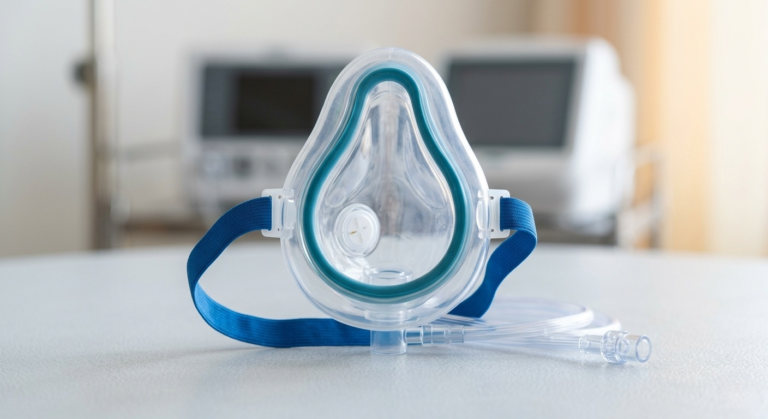
The core function of an anesthesia face mask is sealing. The air cushion design directly determines whether the mask can form an effective seal on the patient’s face and prevent anesthetic gas leakage.
A good cushion should have these characteristics: the inflation valve is well-positioned, inflation and deflation are smooth, the cushion wall thickness is uniform, and the mask conforms to facial contours without excessive manual pressure. Cheap masks often have uneven cushion walls — one side inflates while the other stays flat. You can’t spot this from product photos. You need physical samples.
Ask the factory for air-tightness test reports, and conduct your own fit-testing with actual clinical staff if possible.
15mm/22mm Standard Connectors: Ensuring Compatibility with Breathing Circuits
Anesthesia face masks connect to breathing circuits through a standard 15mm ID / 22mm OD connector. This seems like a small detail, but if the connector dimensions are off, the mask won’t attach securely to the breathing circuit. A mid-surgery disconnection is a serious safety incident.
Reputable factories manufacture connectors to ISO 5356-1 standards. But smaller workshops sometimes lack the mold precision to hit the right tolerances. During inspection, always test-fit the masks with the actual breathing circuits your end users will be using. Don’t just measure dimensions — test the real connection.
EO Sterilization and Packaging Labels: Don’t Let Compliance Issues Block Your Shipment
Disposable anesthesia face masks are typically sterilized with EO (ethylene oxide) and individually packed in PE bags. Importers need to confirm several things: shelf life after sterilization (usually 3-5 years), EO residual levels compliant with ISO 10993, and complete label information on the outer packaging (product name, size, lot number, manufacturing date, expiration date, sterilization indicator).
Don’t Overlook Label Language Requirements
If your target market requires labels in a specific language (Arabic, French, Portuguese, etc.), confirm this with the factory before placing the order. Discovering non-compliant labels after the goods arrive at port is a nightmare — relabeling costs more than reproducing the entire batch in some cases.
MOQ, Lead Time, and After-Sales: How to Structure Your First Order
Here’s a practical reality. Many importers want to push the MOQ (Minimum Order Quantity) as low as possible on their first order. That’s understandable, but factories schedule molds and production lines based on batch volumes. If the MOQ is too low, the factory either won’t accept the order or the unit price becomes unreasonable.
Trial Order Strategy
A sensible approach: treat your first order as a trial run with a moderate volume (say 5,000-10,000 pieces). The primary goal is to verify product quality and the factory’s delivery capability, not to stock up.
Lead Time Expectations
Standard products typically require 30-45 days. Customized products (custom colors, printed logos, specific packaging) add another 15-20 days.
After-Sales Terms to Negotiate
Focus on the factory’s complaint handling process. Do they have a clear return and replacement policy? A reliable factory will specify quality claim response times and resolution procedures in the contract.
Final Thoughts
Sourcing anesthesia face masks is not like buying commodity goods. Every detail is tied to patient safety in the operating room. Price matters, of course, but buying substandard products to save a few cents per unit carries consequences far greater than the savings.
Instead of mass-sending inquiries on Alibaba, spend your time going through these 7 questions with each potential supplier one by one. A factory that can answer all of them clearly and confidently is usually one worth working with.