
Respiratory Consumables in the USA: A B2B Guide to FDA Compliance, Quality, and Reliable Sourcing

The U.S. healthcare system depends on a continuous supply of respiratory products across hospitals, clinics, emergency departments, home healthcare providers, long-term care facilities, and medical distributors.
Products such as oxygen masks, nebulizer kits, breathing circuits, suction catheters, respiratory filters, oxygen tubing, and related patient interfaces may appear relatively simple. However, from a procurement perspective, they require disciplined manufacturing, consistent specifications, controlled labeling, appropriate regulatory documentation, and reliable supply-chain management. Consequently, for U.S. healthcare buyers, distributors, and hospital procurement teams, choosing a respiratory consumables supplier involves much more than a simple price comparison.
Key questions guide this evaluation process:
- Can the manufacturer consistently meet defined product specifications?
- Does the supplier understand applicable U.S. regulatory requirements?
- Are production and quality processes strictly controlled?
- Can the manufacturer support OEM and private-label requirements?
- Can production scale effectively with demand?
- Are documentation and labeling properly managed?
- Can the supplier provide responsive technical and commercial support?
Key takeaway: A reliable respiratory consumables manufacturer should combine product expertise, controlled manufacturing, regulatory awareness, scalable capacity, traceability, and dependable B2B service.
Respiratory Consumables Are Not One Regulatory Category
The U.S. market for medical devices includes both domestic manufacturers and international suppliers serving American distributors, healthcare organizations, and private-label brands. Procurement decisions should always begin with the intended use and applicable regulatory framework rather than relying solely on a product’s marketing name. Specifically, the FDA explains that determining whether a product is a medical device starts with its intended use and indications, followed by identifying an appropriate product classification.
Furthermore, “respiratory consumables” represent a commercial category rather than a single FDA classification. Different products follow distinct regulatory pathways. For instance, the FDA identifies oxygen masks under 21 CFR 868.5580 and lists product code BYG as a Class I device with 510(k) exemption. Conversely, direct-patient-interface nebulizers fall under 21 CFR 868.5630 as Class II devices, while alternative nebulizer configurations carry different classifications.
This distinction matters immensely to procurement teams. Rather than accepting a blanket regulatory claim covering an entire product family, buyers must evaluate the regulatory status applicable to each specific device, intended use, configuration, and market application.
What U.S. Buyers Should Evaluate
When qualifying a respiratory consumables manufacturer, procurement teams should review several critical pillars:
- Product classification: Understand how the specific device is classified for the intended U.S. market.
- Regulatory pathway: Determine whether the product is subject to premarket notification, exemption, or another applicable pathway.
- Quality management system: Confirm that manufacturing processes operate under an appropriate quality system.
- Product specifications: Review dimensions, materials, connectors, packaging, and other relevant technical requirements.
- Traceability: Establish how batches, lots, materials, and finished products are identified and controlled.
- Labeling: Verify that product and packaging information suits the intended market.
- Production capacity: Determine whether the manufacturer can support both current demand and future volume increases.
- Complaint and service processes: Understand how quality issues and customer complaints are investigated and resolved.
FDA Quality Requirements for Respiratory Consumables
Quality management remains one of the most important factors when sourcing respiratory products for the U.S. market. As of February 2, 2026, the FDA’s Quality Management System Regulation (QMSR) is fully effective. This regulation amends 21 CFR Part 820 and incorporates ISO 13485:2016 by reference, harmonizing the FDA’s device quality framework more closely with internationally recognized standards. Consequently, systematic quality management has become an indispensable baseline for commercial manufacturing.
An effective manufacturing quality system addresses multiple operational areas:
- Supplier and raw-material controls
- Incoming inspection
- Production process controls
- In-process and finished-product inspection
- Equipment and process controls
- Packaging controls
- Identification and traceability
- Nonconforming product control
- Complaint handling
- Corrective and preventive actions (CAPA)
- Document and change control
The ultimate objective is consistency. A respiratory mask, catheter, filter, or nebulizer kit should not merely pass inspection once; the manufacturing system must repeatedly produce items that conform to approved specifications.
Why Quality Consistency Matters
For distributors and hospital procurement teams, inconsistent products generate severe downstream complications, including:
- Higher product rejection rates
- Additional incoming inspection overhead
- Customer complaints and product returns
- Inventory disruption and emergency replacement orders
- Increased operating costs
Therefore, experienced buyers evaluate the manufacturing process behind the product rather than relying solely on initial qualification samples.
HME Medical Equipment, Respiratory Consumables, and Value Medical Supplies
Respiratory care extends far beyond hospital walls. Home healthcare providers, DME distributors, rehabilitation organizations, and long-term care facilities generate substantial demand for respiratory products and HME medical equipment. For these businesses, purchasing decisions balance clinical suitability, product consistency, availability, and cost.
Defining True Value in Medical Supplies
The term “value medical supplies” should never be interpreted simply as low-cost products. Instead, a practical procurement model defines total value as:
Total Procurement Value=Product Quality+Supply Reliability+Regulatory Support+Service−Cost Efficiency
This formula proves especially relevant for high-volume respiratory consumables. For a distributor purchasing hundreds of thousands of units annually, a minor improvement in defect rates or delivery reliability yields a much greater financial impact than a marginal reduction in unit price.
What Defines High-Quality Medical Equipment?
Objective manufacturing controls must support the phrase “high quality medical equipment” rather than empty marketing language. Buyers should evaluate material consistency, dimensional accuracy, connector compatibility, product and packaging integrity, lot identification, functional performance, cleanliness requirements, storage conditions, and shelf-life controls. Specific testing and acceptance criteria should always align with individual product requirements.
Core Portfolio: Oxygen Masks, Nebulizer Kits, and Suction Catheters
Specialized manufacturers offer significant advantages when their production concentrates exclusively on respiratory products. Common categories include:
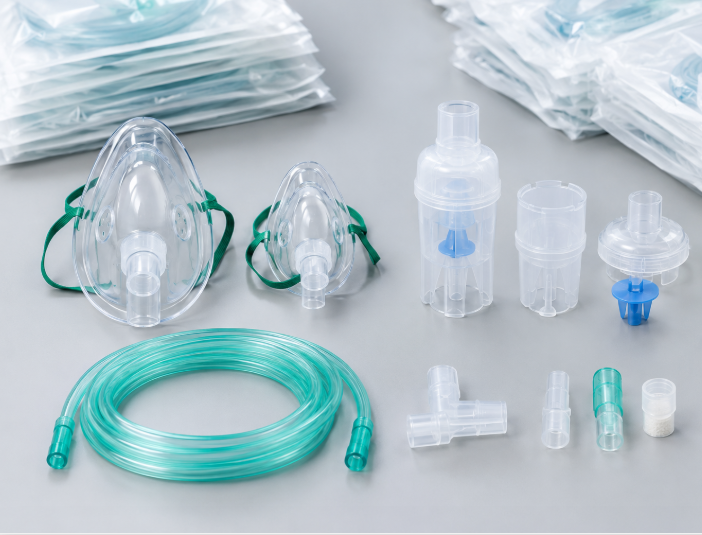
- Oxygen Masks: These provide patient interfaces for oxygen delivery in clinical applications. The FDA classification database separately identifies several mask configurations, highlighting why product-specific regulatory evaluation is essential.
- Nebulizer Kits: These deliver aerosolized medication through an appropriate patient interface, spanning direct-patient-interface and ventilator-compatible configurations.
- Suction Catheters: These play a vital role in airway management and secretion removal applications.
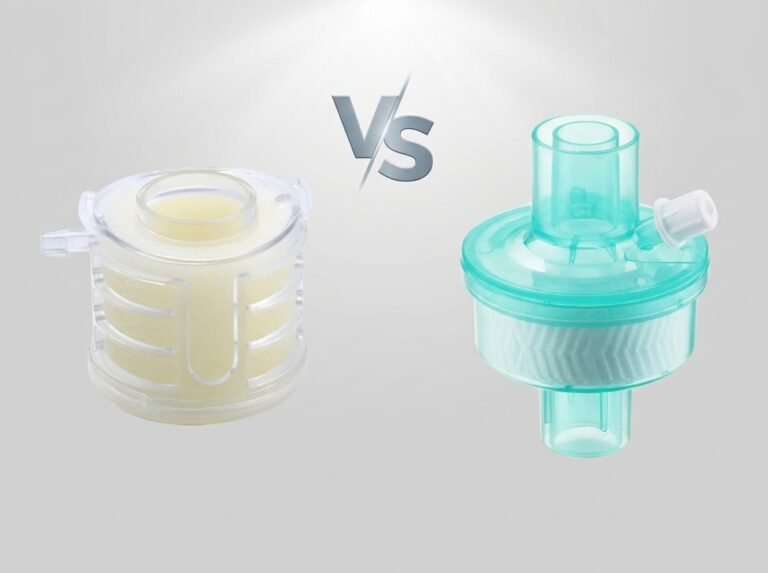
- Respiratory Filters and Breathing Accessories: These items serve diverse clinical or equipment setups. Buyers must evaluate connection compatibility, airflow characteristics, filtration performance, material construction, packaging, testing, and intended use.
Partnering with a manufacturer specializing exclusively in respiratory consumables allows buyers to access more focused technical support than they would find with a general medical trading company carrying hundreds of unrelated product categories.
Transparency and Traceability: Labeling and Digital Catalog Management
In medical procurement, documentation forms a core component of the supply chain. Even a technically acceptable product creates operational friction if its packaging, labeling, product identification, or supporting documents are inconsistent.
What Medical Supplies Labels Must Communicate
Labels typically convey product names, model or catalog numbers, manufacturer details, lot or batch numbers, expiration dates, manufacturing information, sterility details, storage conditions, warnings, precautions, and applicable symbols. The FDA mandates general medical device labeling requirements under 21 CFR Part 801, alongside specific device-category rules.
Why Traceability Matters
For distributors and hospital procurement organizations, traceability provides an essential mechanism for tracking products and investigating quality issues. A controlled system connects:
Raw Material→Production Batch→Finished Product→Packaging→Shipment→Customer
This end-to-end visibility proves invaluable when investigating customer complaints, product deviations, batch-specific issues, returns, corrective actions, or recalls. Furthermore, professional medical device catalogs should provide robust procurement data rather than merely attractive images.
OEM Branding and Private Labeling
Private-label customers frequently require custom branding across cartons, packaging, and labels. A medical equipment logo forms a critical part of an OEM program, though branding must be managed separately from mandatory regulatory information. This separation is vital when products are manufactured overseas and distributed under a U.S. company’s brand.
Building International Supply Chains and Biomedical Networks
The U.S. medical technology market encompasses major corporations, established distributors, specialized manufacturers, startups, and emerging medical device companies. Many emerging innovators possess strong product concepts but require experienced manufacturing partners to scale from prototyping to commercial volumes.
Because healthcare manufacturing spans global borders, a typical product involves:
International Raw Materials→Specialized Manufacturing→Quality Inspection→Packaging→Export→U.S. Importation→Distribution→Healthcare Delivery
Consequently, managing international biomedical device supply chains requires far more than finding a factory with a competitive quotation. Reliable suppliers provide active visibility into production schedules, quality status, documentation, packaging, shipment preparation, order changes, and potential supply disruptions—factors that directly influence inventory planning and customer service.
Furthermore, a supplier’s responsibility does not end when an order leaves the factory. For international B2B customers, ongoing support covers technical questions, specification reviews, packaging coordination, quality investigations, and repeat orders. Responsiveness is especially critical when working with overseas manufacturers, as communication delays can quickly disrupt the entire supply chain.
Practical Procurement Checklist for U.S. Respiratory Consumables Buyers
Before approving a respiratory consumables supplier, procurement teams can evaluate them against this systematic checklist:
- Product: Do products match required intended use? Are specifications, materials, dimensions, connector compatibility, and packaging clearly documented?
- Regulatory: Is the FDA product classification evaluated? Are pathways, registrations, listings, exemptions, and labeling strictly controlled?
- Manufacturing: Does the manufacturer specialize in respiratory products? Can they support required volumes? Are raw materials, production processes, inspections, and lot traceability maintained?
- OEM: Can packaging, private-label requirements, and artwork be customized and scaled safely as demand grows?
- Supply Chain: Are lead times predictable? Can the manufacturer support repeat orders, resolve quality issues quickly, and maintain responsive communication?
Suppliers performing consistently across these categories are vastly better positioned for long-term collaboration than those competing solely on low unit prices.
Why Weishan Tech Focuses Exclusively on Respiratory Consumables
Weishan Tech positions itself as a specialized manufacturer focused entirely on medical respiratory consumables. This dedicated model allows the company to concentrate its production resources, quality controls, technical expertise, and OEM capabilities exclusively on respiratory care rather than dispersing attention across unrelated medical devices.
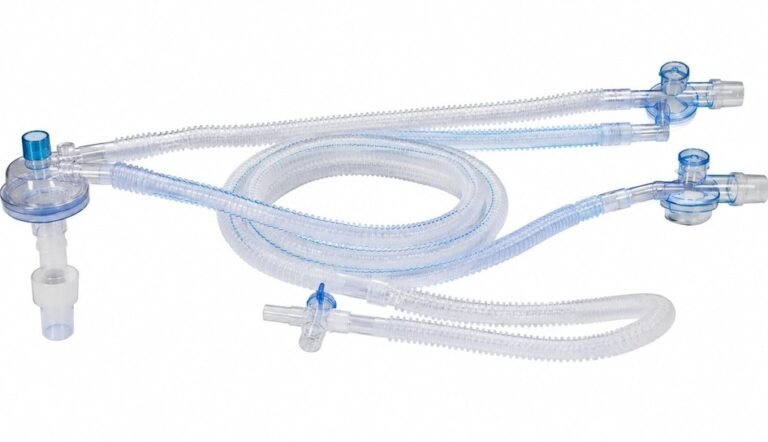
For U.S. distributors, importers, HME providers, and healthcare supply companies, this specialization supports a streamlined and focused procurement relationship. Weishan Tech’s comprehensive portfolio covers oxygen masks, nebulizer kits, suction consumables, breathing circuits, respiratory filters, oxygen tubing, and patient interfaces.
Ultimately, the manufacturing objective remains straightforward: combine consistent products, controlled quality, scalable production, reliable documentation, and responsive B2B support. For organizations building long-term respiratory supply programs, this integrated approach delivers far greater value than sourcing fragmented products from multiple unrelated factories.
FAQ
Buyers should verify the product’s intended use, applicable FDA classification and regulatory pathway, quality management system, manufacturing controls, product specifications, labeling, traceability, testing documentation, production capacity, and complaint-handling procedures. Regulatory requirements differ by product, so buyers should evaluate each device individually rather than relying on a general “FDA compliant” statement.
Yes. An experienced manufacturer can support OEM and private-label programs involving product specifications, packaging, labeling artwork, branding, production, and export documentation. However, the U.S. buyer and manufacturer should clearly define regulatory responsibilities, labeling requirements, product ownership, change control, and final approval before commercial production begins.
Supplier evaluation should consider more than unit price. Procurement teams should compare product consistency, regulatory readiness, quality controls, manufacturing capacity, documentation, traceability, lead times, OEM capabilities, complaint handling, communication, and long-term supply reliability. For high-volume respiratory products, a supplier’s ability to maintain consistent quality and uninterrupted supply can have a greater commercial impact than a small difference in purchase price.
Conclusion: Build a Reliable Respiratory Supply Chain, Not Just a Purchase Order
The U.S. respiratory care market requires a supply chain that can balance clinical requirements, regulatory awareness, manufacturing quality, cost efficiency, and supply continuity.
For distributors, hospitals, HME providers, importers, and private-label businesses, sourcing respiratory consumables should therefore begin with supplier qualification rather than price comparison.
A strong manufacturing partner should understand the products, maintain controlled production processes, manage documentation and labeling carefully, support OEM requirements, scale with demand, and respond quickly when issues arise.
Whether a buyer is evaluating domestic suppliers, medical device manufacturers in USA, international OEM factories, or suppliers connected to major healthcare hubs such as New Jersey, the fundamental procurement principle remains the same:
Choose a manufacturer that can deliver consistent quality and reliable supply at commercial scale.
For U.S. healthcare buyers seeking a specialized respiratory manufacturing partner, Weishan Tech provides a focused manufacturing platform for respiratory consumables, supported by scalable production, stringent quality control, OEM/ODM capabilities, and international B2B supply-chain experience.